DeepOHeat: Operator Learning-based Ultra-fast Thermal Simulation in 3D-IC Design
1University of California, Santa Barbara2Cadence Design Systems
Thermal design of a 3D chip needs many heat simulations, and each finite-element run takes minutes to hours. DeepOHeat learns the operator that maps a design’s configuration, such as its power map and boundary conditions, to its full 3D temperature field, and it is trained on the heat equation alone, with no simulation data. For designs it has not seen, it matches the commercial solver Celsius 3D to within 0.16% mean error, 1000× to 300000× faster.
Abstract
Thermal issue is a major concern in 3D integrated circuit (IC) design. Thermal optimization of 3D IC often requires massive expensive PDE simulations. Neural network-based thermal prediction models can perform real-time prediction for many unseen new designs. However, existing works either solve 2D temperature fields only or do not generalize well to new designs with unseen design configurations (e.g., heat sources and boundary conditions). In this paper, for the first time, we propose DeepOHeat, a physics-aware operator learning framework to predict the temperature field of a family of heat equations with multiple parametric or non-parametric design configurations. This framework learns a functional map from the function space of multiple key PDE configurations (e.g., boundary conditions, power maps, heat transfer coefficients) to the function space of the corresponding solution (i.e., temperature fields), enabling fast thermal analysis and optimization by changing key design configurations (rather than just some parameters). We test DeepOHeat on some industrial design cases and compare it against Celsius 3D from Cadence Design Systems. Our results show that, for the unseen testing cases, a well-trained DeepOHeat can produce accurate results with 1000× to 300000× speedup.
Learn the solution operator, not one solution
In steady state, the temperature T of a chip with conductivity k and internal power qV follows the heat equation, and each exposed surface adds a boundary condition: a fixed temperature, a fixed heat flux (a 2D power map is one), an insulated surface, or convection with a heat transfer coefficient h.
Power maps and heat transfer coefficients are functions, and changing them changes the problem itself, so a model that takes a few design parameters cannot cover them. Earlier neural models either predict only 2D fields or do not carry over to new configurations. DeepOHeat learns the operator Gθ from the configuration functions to the temperature field, so one trained model serves every design drawn from the same family.
A multi-input DeepONet
Each configuration is sampled at fixed points and sent to its own branch net: a 21 × 21 power map becomes 441 numbers, and a uniform heat transfer coefficient a single one. A point y in the chip goes to a trunk net whose first layer maps it to Fourier features, which helps with sharp temperature changes. The temperature at y is the sum of the element-wise product of all the nets’ outputs.
Trained by the physics
A single finite-element run of a complex chip can take hours, so collecting enough simulations to train on is not practical. DeepOHeat instead minimizes the residual of the heat equation inside the chip plus the residual of every boundary condition and power map on its surface, computed with automatic differentiation for randomly drawn configurations. Training needs no solver output at all; the solver is only used to test.
Results
Two industrial test cases, each a single cuboid chip of about 1 mm × 1 mm × 0.5 mm, compared point by point with Celsius 3D, Cadence’s finite-element solver, on configurations the model never saw in training.
Unseen power maps
The top surface carries a 2D power map; the sides are insulated and the bottom cools by convection. DeepOHeat trains for 10,000 iterations, 10 hours on one V100, on random smooth power maps drawn from a Gaussian random field. It is then tested on ten block-style power maps from Celsius 3D, from a uniform map to an irregular one with many small heat sources. Its fields match the solver’s closely: the mean error stays between 0.02% and 0.16%, and the peak error between 0.10% and 1.00%. On the most irregular map, it slightly overestimates the temperature between the small heat sources.
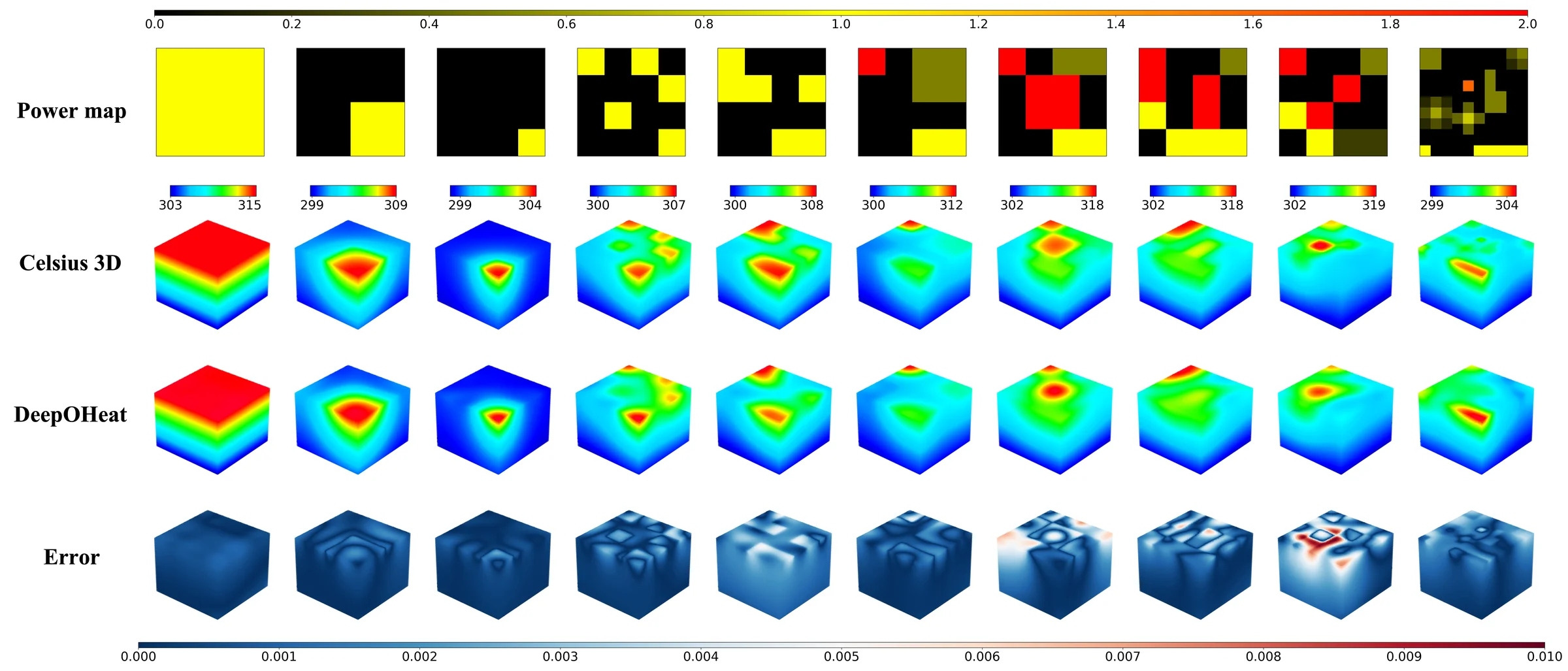
Scroll sideways to see all ten maps.
Show the numbers
| Power map | Mean error (%) | Peak error (%) |
|---|---|---|
| p1 | 0.03 | 0.10 |
| p2 | 0.03 | 0.20 |
| p3 | 0.02 | 0.24 |
| p4 | 0.05 | 0.38 |
| p5 | 0.14 | 0.52 |
| p6 | 0.04 | 0.49 |
| p7 | 0.13 | 0.71 |
| p8 | 0.07 | 0.66 |
| p9 | 0.16 | 1.00 |
| p10 | 0.08 | 0.40 |
Heat transfer coefficients as inputs
A second model takes the heat transfer coefficients of the top and bottom surfaces as two inputs, each drawn from 333.33 to 1,000 W/m2K in training, with a thin layer of volumetric power inside the chip. After 5,000 iterations, about 2 hours, it matches Celsius 3D on unseen pairs to within 0.032% mean error. These coefficients change the field only slightly, and DeepOHeat still follows the change.
| Top and bottom HTC (W/m2K) | Mean error | Peak error |
|---|---|---|
| 1,000 and 333.33 | 0.032% | 0.043% |
| 500 and 500 | 0.011% | 0.025% |
Speed
One Celsius 3D run takes about 5 minutes for the power-map case and 2 minutes for the heat-transfer case. A DeepOHeat prediction takes 0.1 s on the same CPU and 0.001 s on a V100 GPU. For larger designs the solver’s cost grows, while DeepOHeat’s stays the same.
| Test case | Celsius 3DXeon Gold 6148 | DeepOHeatsame CPU | DeepOHeatTesla V100 |
|---|---|---|---|
| Power map | ≈ 5 min | 0.1 s3,000× | 0.001 s300,000× |
| Heat transfer | ≈ 2 min | 0.1 s1,200× | 0.001 s120,000× |
Scope and follow-up work
- Test cases. Both experiments use a single cuboid chip. More complex geometries and optimizing 3D power maps are left for future work.
- Test inputs. Celsius 3D power maps are tile-based, so they are interpolated to DeepOHeat’s 21 × 21 grid for testing, which also smooths them.
- Follow-up work. DeepOHeat-v1 (IEEE TCPMT 2026) makes the model more accurate, efficient and trustworthy, and DeepOHeat-v2 adds self-improving training for thermal optimization of multi-die 3D-ICs.
Citation
@inproceedings{liu2023deepoheat,
  author    = {Liu, Ziyue and Li, Yixing and Hu, Jing and Yu, Xinling and Shiau, Shinyu and Ai, Xin and Zeng, Zhiyu and Zhang, Zheng},
  title     = {{DeepOHeat}: Operator Learning-based Ultra-fast Thermal Simulation in {3D-IC} Design},
  booktitle = {2023 60th ACM/IEEE Design Automation Conference (DAC)},
  pages     = {1--6},
  year      = {2023},
  address   = {San Francisco, CA, USA},
  publisher = {IEEE},
  doi       = {10.1109/DAC56929.2023.10247998},
  url       = {https://ieeexplore.ieee.org/document/10247998}
}